Do you have a knack for finding sales leads?
If you’re an expert at generating sales leads, you can make a good income by starting your own lead generation business or agency.
And since sales prospecting is one of the hardest parts of selling anything, your lead generation skills are in high demand. Even better, your expertise is likely transferrable across different products, services, and industries.
Curious about how to run a lead generation business of your own? Keep reading to find out what steps you should follow to launch your agency and how to grow your success—from setting up shop to optimizing your strategy.
What is a Lead Generation Business?
Lead generation is such a complex and valuable process that there are entire businesses dedicated to this single aspect of sales. A lead generation business works by finding leads that fit a client’s criteria and then handing off those leads for a fee.
There are several variations of the lead generation business model. Some lead generation agencies act as affiliate marketers, receiving payment only when one of the leads they’ve supplied converts into a customer; while other lead generation businesses charge simply for sourcing and supplying qualified leads to their clients.
What’s the Outlook for Lead Generation Agencies?
Are lead generation services in high demand? Heck yes! Not only do marketing teams name lead gen as one of the most difficult aspects of their jobs, but US companies are investing more heavily into lead generation than ever before.
In a 2020 survey, 61% of marketers named generating traffic and leads as their number one challenge.

Businesses are increasing their budgets for lead generation activities across the board. According to Statista, the budget for lead generation ads is growing steadily, with a forecasted spend of $3.2 billion by the end of 2023.
While that figure doesn’t directly correlate with the amount spent on outsourcing lead gen, it does prove that there’s a considerable piece of the pie up for grabs—especially for lead gen agencies that find and sell high-quality leads at a premium.
You can see evidence of this in the success of top-performing lead generation companies, many of which charge clients a hefty price tag to provide leads. For example, according to their website, lead generation agency Belkins charges up to $360,000 per year to provide a client with around 1,500 prospect meetings per month.
All this to say that, for salespeople with the appropriate skillset, running a lead generation agency can be quite a lucrative business. Interested? Let’s walk through the steps you should follow to start a lead gen business from scratch.
How to Start Your Own Lead Generation Business
Step 1: Choose a Niche
First, decide what type of business you want to generate leads for. You won’t need to stick to one industry or business type forever but choosing a niche to focus on initially can help you get your footing. Once you’ve established yourself as a lead generation expert and gained some brand recognition, you can always expand or pivot to meet market demand.
We recommend creating an ideal customer profile that you can refer back to and tweak as you learn more about your business. Factor in details like whether your ideal customers are local businesses or remote (and whether location is a relevant factor to you), what industry they’re in (ecommerce, real estate, SaaS, etc.), how big or small their companies are, including how many employees they have, their typical sales volume, and annual revenue.
When first choosing an area of focus for your lead gen agency, ask yourself:
- Where does my lead gen expertise lie?
- What do my ideal clients all have in common?
- How competitive is the market?
In most cases, the answers involve tapping into industries and demographics that you know well and are confident in your ability to generate leads for. If you have experience or connections in a certain industry already, use those to your advantage.
Step 2: Define a Business Model
What type of lead gen agency do you want to operate? Before you can begin to promote your business, you need to establish how you’ll charge clients and exactly what type of lead generation services you’ll offer.
Decide how you want to make money and how much you’re going to charge. Not sure what type of fee structure makes the most sense for your agency? A retainer-style agreement would allow you to secure recurring income from clients who need a continual source of fresh leads, while a pay-per-lead business model would scale your income along with your output.
You’ll also need to decide which lead gen activities you’ll offer and what type of leads you plan to provide. How much lead nurturing (if any) you will handle yourself? Will you conduct initial outreach so you can provide warm introductions or simply hand off lead information and contact details to your client? Generating cold leads is less time-consuming than drumming up sales-qualified leads—but qualified leads will result in a higher conversion rate for your clients.
Consider how you can deliver the most value and define exactly what services you’ll offer before moving to the next step.
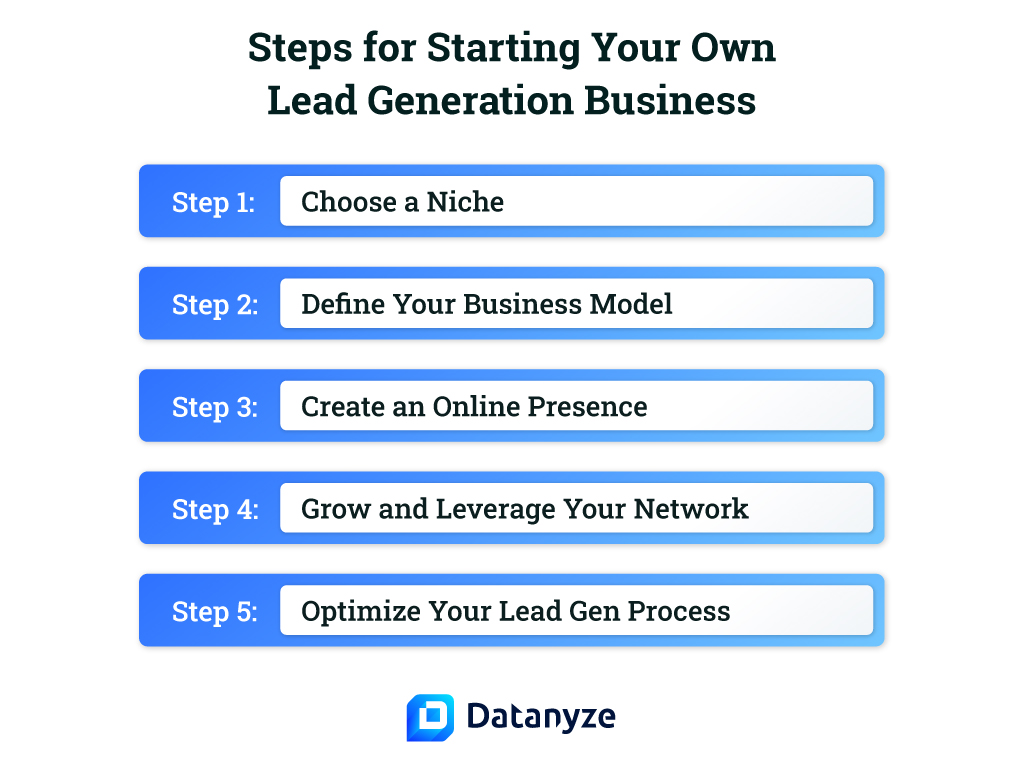
Step 3: Establish an Online Presence
Once you’ve nailed down your niche and business model, it’s time to get your business online. You need to establish an online presence for yourself and your brand so you can get on customers’ radar (and start generating leads of your own!).
This step involves creating pages on relevant social media platforms to promote your new business. You’ll also want to purchase a domain and launch a simple website with a contact form so you can capture leads who land on the site. Update your personal LinkedIn profile (and website if you have one) to highlight your new position and include a link to your company website.
As your business grows, you can add more content to your website and expand your digital footprint. Eventually, you may want to create dedicated landing pages for PPC campaigns, populate your blog with SEO-friendly content, and publish client success stories to highlight your impact and provide social proof.
Step 4: Grow and Leverage Your Network
The next step is to find businesses that need your services and let them know you’re ready and waiting to help them generate new leads. Start by reaching out to your existing connections to share that you’ve launched a new lead generation business.
Join LinkedIn groups, online communities, and industry forums where you can find more of your potential customers. Connect with potential clients and referral sources, including business owners, marketers, and sales reps who fit your ideal customer profile.
A lead generation tool like Datanyze can help streamline this step and get your business up and running more quickly. For example, you can use LinkedIn to search for companies in your niche and individuals with roles in outbound sales, demand gen, and marketing who might be interested in your services.
With Datanyze, you can quickly collect their contact information so you can focus on connecting and building relationships. Once you have a list of lead email addresses, you can use email marketing to nurture prospects who aren’t quite ready to convert.
Step 5: Optimize Your Lead Gen Process
To keep your business running sustainably, you need to establish best practices so you can learn from your mistakes and experience. This involves keeping your eyes (and mind) open for new opportunities to deliver value to existing clients, attract new customers, and increase operational efficiency.
Of course, as a lead generation business, increasing efficiency hinges largely on finding ways to improve both the quality and quantity of the leads you sell to clients. There are plenty of ways to approach optimizing your lead gen process, ranging from investing in lead generation tools like Datanyze to identifying your best lead sources and tracking KPIs.
Below, we’ll take a closer look at some of the best options for optimizing your lead generation process and business model.
How to Optimize Your Lead Gen Process (and Your Revenue)
Whether you’re just planning to start your own lead generation business or are looking to improve your existing workflow, here are some tips for optimizing the lead gen process.
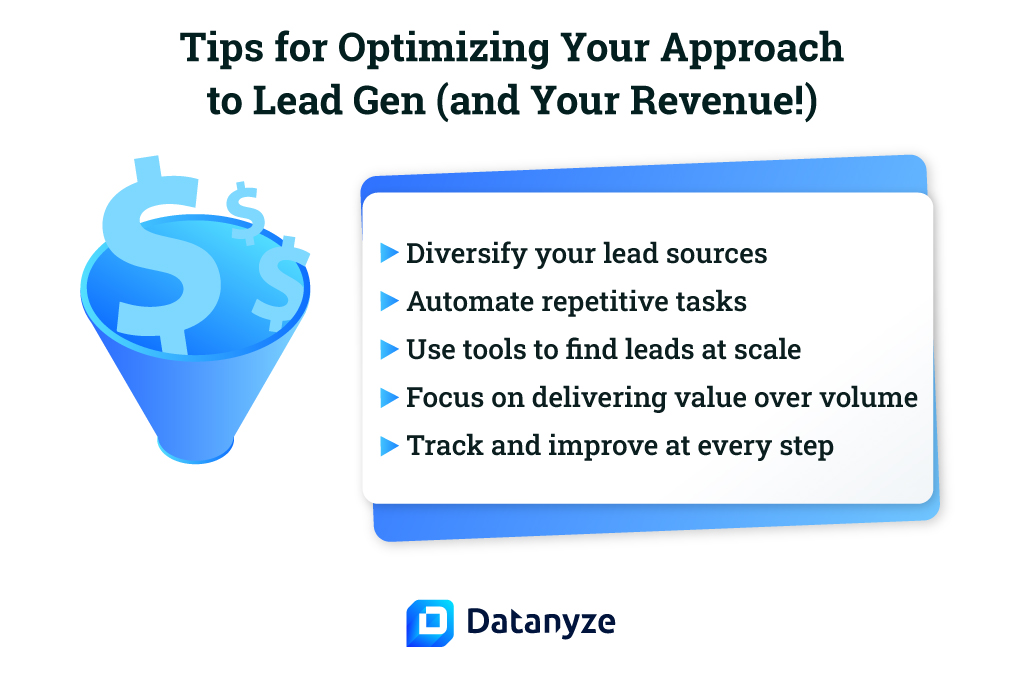
Diversify Your Lead Sources
Put simply, don’t put all your eggs in one basket. Instead, establish several reliable lead acquisition channels, so if one source dries up or slows down, you’re not left empty-handed.
Consider tapping into the power of content marketing and inbound lead gen by offering lead magnets (downloadable email templates, for instance) with lead capture forms on your landing pages. Or create a referral network to drive more leads from your customer pool and offer discounts or bonuses for every successful referral. You can use these approaches to attract your own business leads as well as to draw in more prospects for your customers.
Automate Lead Management Tasks
Running a successful business means finding the smartest way to get results without sacrificing quality. Sales intelligence and marketing automation are some of the best investments you can make for your lead generation agency.
For example, you can set up a CRM to automatically track your clients and conversations or use lead management software to funnel leads into the appropriate funnel or email sequence. There are tons of lead intelligence tools that can help you manage both your leads and your customers’ leads.
Use Tools to Find Leads at Scale
We recommend using lead gen tools to accomplish more in less time. The best lead generation tools make it simpler to find high-value leads and validate their contact data—so you can hand off leads to your clients with full confidence in your data.
With Datanyze, for example, you can find and connect with high-quality leads at scale while you browse LinkedIn. This means you can source more leads in less time (both for your own business and for your B2B clients).
Prioritize Value Over Volume
If you can provide a select number of pre-vetted, high-value sales leads (rather than a huge amount of unqualified leads), your clients will likely see more conversions and stick with your services long-term. Consider whether you can attract leads lower in the funnel or help your clients tap into a less saturated market segment.
You should also look for opportunities to scale up existing retainers. Weigh the benefits of upselling and cross-selling additional services, like pre-qualifying leads, making warm introductions, and even sales coaching.
Track and Improve at Every Step
The only way to truly optimize your lead generation process sustainably is to track KPIs that allow you to improve your lead sources, quality, and volume. Even if your business is a well-oiled lead-generating machine, you’ll learn more as you go about sourcing leads for clients in different industries and niches.
Ready to Take Your Lead Generation Business to the Next Level?
Whether you’re already running a successful lead gen business or just starting out, you can do more for your clients with the right lead generation tools.
Datanyze is designed to help you source high-quality leads from LinkedIn, including accurate contact details, verified email addresses, and up-to-date prospect data.
Sign up for Datanyze and learn how to generate valuable leads for your clients—so you can scale your business and revenue without sacrificing lead quality. Create your free account and try Datanyze today!
